
Tasting the Truth
Minister's Letter: October 2025

Dear Grace Church,
In a few days, we will mark and celebrate 10 years of Grace Church.
This weekend, we want to honour those who have given so much in their service of this wee congregation from its first day until now.
But ultimately we want to give thanks and praise to God for his faithfulness in starting and sustaining this fellowship.
We would love to see you either at the party on Saturday, or the thanksgiving service on Sunday morning, where Paul Clarke will be preaching, or our Reformation Sunday Evening Meeting.
“I have manifested your name to the people whom you gave me out of the world. Yours they were, and you gave them to me, and they have kept your word.”
-John 17.6
These words from the prayer of Jesus on the night before his death were described by John Knox to his wife on his own death bed as where “I cast my first anchor.” Here Knox saw the rich comfort of the steadfast love of God which had been fixed on him since before the ages began and also the foundation for his justification by faith alone.
The Reformation is marked each year on 31st October, the date when Martin Luther posted his 99 Theses challenging excesses and accretions in Roman Catholic doctrine and practice. Churches within the Reformation tradition have sometimes commemorated that on the Sunday closest to 31st October. This year that would be 2nd November. In our Sunday Evening Meeting this week, we will spend some time considering the Scottish Reformation in particular, and how that heritage might inform our worship and witness today.
John Knox was the public face of the Reformation with his strident zeal for the glory of God and his strong preaching for the reform of the church. His life is rich with controversy and excitement and we won’t be able to spend too much time exploring it on Sunday. In this month’s letter, I wish just to highlight Knox’s own discovery of the gospel of grace and his call into the Ministry.
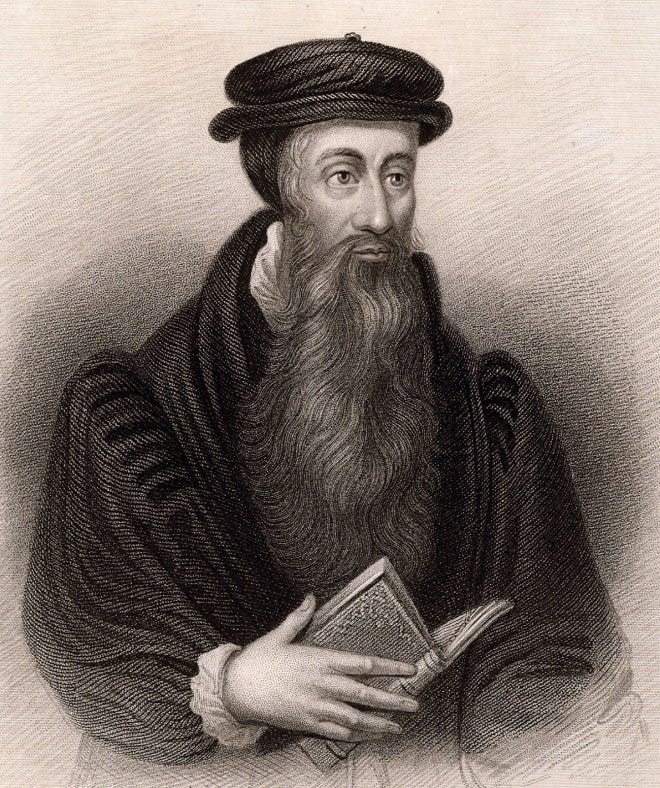
John Knox, from Haddington in East Lothian, studied in St Andrews and was ordained as a Priest in the Roman Catholic Church in the 1530s. He went on to become an Apostolic Notary, which is an expert in Church Law. Yet it was during the 1540s when his life was upended. Instead of maintaining the Church’s structures through the study of its law, he would give himself to the proclamation of God’s Scriptures to see the complete renewal of the church in Scotland. Through two travelling preachers, Thomas Gillem and John Rough, both former Dominican Priests, it is said that Knox first “received any taste of truth.” These men spoke of the free gift of justification through faith apart from works. God’s justification of sinners was not built on good works, adherence to Church dictates, or family names, but solely the grace of God found in Jesus Christ alone.
A number of years later, captivated by the preaching and vision of reformation presented by George Wishart, Knox joined his company. He became a bodyguard of sorts carrying a two handed sword to protect his mentor from ambush. Wishart, knowing he was to be arrested (and eventually executed), released Knox, saying “Nay, return to your bairns, and God bless you. One is sufficient for a sacrifice.”
As Jane Dawson points out, Wishart became Knox’s blue print for Ministry. It was fundamentally a Ministry of the word. The Minister in Christ’s church was to know the Bible deeply, rooted himself in the Scriptures, and proclaim it clearly and courageously.
In 1547, Knox with a number of students he was tutoring arrived in St Andrews Castle, where a number of other Protestants had found a haven. While there, Knox started a daily reading and expounding of John’s Gospel. Other residents soon started attending.
John Rough, through whom Knox first received a taste of the truth, encouraged him to consider becoming a preacher. Knox rejected this so Rough took more extreme measures. He preached a sermon on Reformed Ministry and how a Minister was called. He then singled out Knox from the pulpit saying he was called. After the sermon, a vote was taken and Knox was called to be a preacher of the word. At this point he ran out crying. He battled with this until one week when he was in Holy Trinity, the town church. The people listening to the Dean of the church longed for someone who would preach the word clearly. So they also took and vote and they called him. This time he accepted it, and gave his lift to sounding the trumpet of God’s word in Scotland throughout Europe, inviting all to feast on the truth of the Bible.
In Christ,
Ciarán R. Kelleher
October Treat
Vellum was an old form of material, manufactured from cow skin, which was used for writing and printing. A Gutenberg Bible in the 15th century printed on Vellum required 170 calves. The cost for that Bible was enormous.
Nowadays, we can buy Bible for pennies, yet still in parts of the world today, even Pastors in local churches struggle to source and afford one. Below is an encouraging report about one initiative seeking to the get the Word of God into the hands of the people of God.
Home Group: Ecclesiastes 7.15-29
What is the reality of the world we live in that the Preacher has observed (v15) and where else do we see that in the Bible? What kind of religion and lifestyle is the Preacher cautioning us against in vv16-17? How are we to be towards God instead (v18)?
In what kind of situations is wisdom helpful for us (v19)? According to the Preacher, how is our wisdom diluted (20-22)?
What was the result of the Preachers search for wisdom (23-24)? What is it that the preacher has found out about humanity (29)? How might these observations and findings humble us and draw us closer to God?